

Wellness Marketing in 2026: The Definitive Guide to Clinical Luxury and Patient Acquisition

Updated: Mar 19
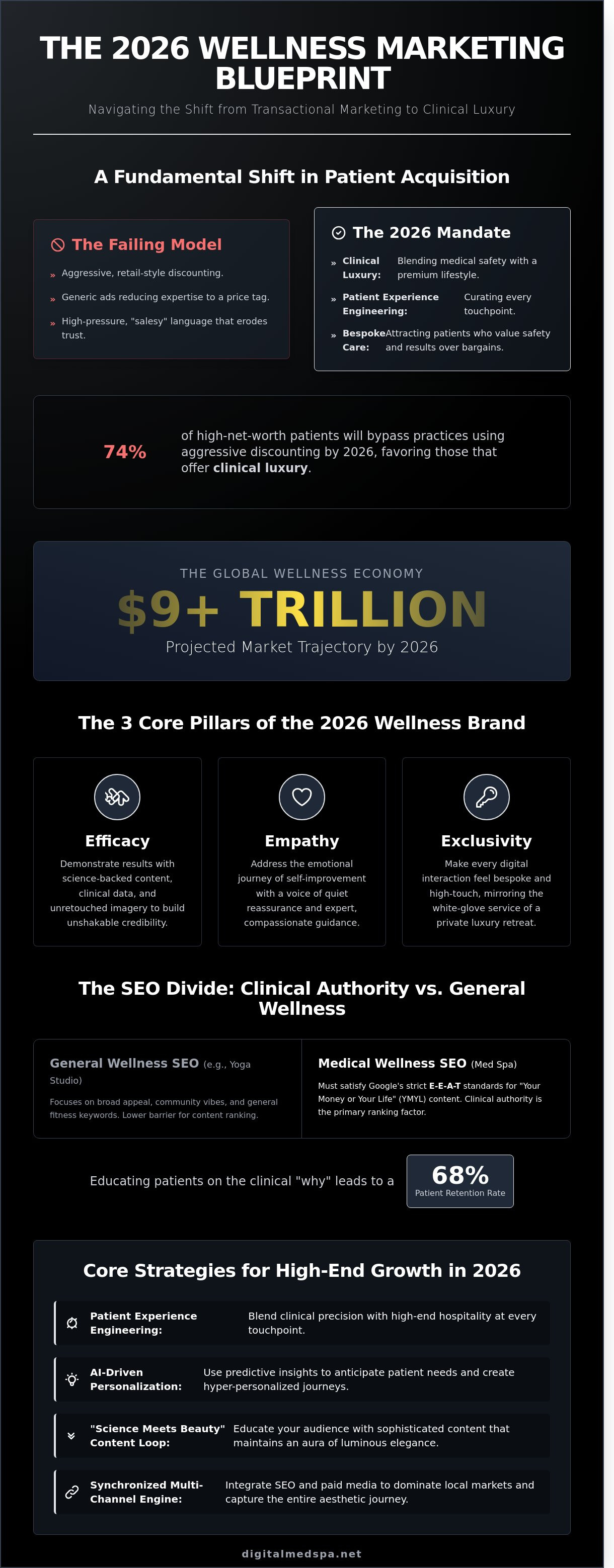
By 2026, data suggests that 74% of high-net-worth patients will bypass practices that use aggressive retail-style discounting in favor of those offering clinical luxury. You've likely felt the frustration of watching your medical expertise be reduced to a mere price tag on a social media tile. It's exhausting to see your marketing budget disappear into generic ads that don't reflect the precision of your work or the luminous results you provide. You know that effective wellness marketing requires a more refined touch to attract patients who value safety and bespoke care over a quick bargain.
This guide provides the blueprint to bridge that gap, helping you build a brand that radiates both clinical authority and premium hospitality. We'll outline the specific 2026 digital trends that allow you to articulate complex procedures with evocative clarity. You'll discover how to secure a steady stream of discerning patients for high-margin treatments like Semaglutide or advanced aesthetics without sacrificing your professional integrity. We're moving beyond the noise to establish a clear roadmap for sustainable, high-end growth.
Key Takeaways
Discover how to elevate your practice through "Patient Experience Engineering," seamlessly blending clinical precision with the bespoke language of high-end hospitality.
Learn to utilize AI-driven predictive insights to transition from mass outreach to hyper-personalized patient journeys that anticipate aesthetic needs before they arise.
Master a sophisticated wellness marketing strategy that employs the "Science meets Beauty" content loop to educate your audience while maintaining an aura of luminous elegance.
Understand how to synchronize SEO and paid media to capture the entire aesthetic journey, ensuring your practice dominates local markets with authority and grace.
Explore the transition from independent growth to professional scaling, focusing on long-term patient lifetime value and refined ROI metrics for the 2026 economy.
Table of Contents Defining Wellness Marketing: The Intersection of Clinical Precision and Holistic Luxury The 2026 Wellness Marketing Landscape: AI, Hyper-Personalization, and Ethical Data Building Aesthetic Authority: Content Strategies That Bridge Science and Radiance The Multi-Channel Engine: Integrated SEO, Paid Media, and Reputation Management Navigating Growth: Scaling Your Practice with Professional Wellness Consulting
Defining Wellness Marketing: The Intersection of Clinical Precision and Holistic Luxury
As we approach 2026, the definition of wellness marketing has evolved from simple visibility to a disciplined practice known as Patient Experience Engineering. This methodology treats every digital and physical touchpoint as a deliberate step in a patient's aesthetic journey. The Global Wellness Institute projects that the global wellness economy is on a trajectory to surpass $9 trillion by 2026. Within this massive expansion, med spas have emerged as the new gold standard for consumers who refuse to choose between medical safety and a premium lifestyle experience. It's a shift that requires a departure from the transactional nature of traditional retail promotion.
Traditional retail marketing often fails in the medical wellness space because it relies on high-pressure tactics and volume-based discounts. These methods tend to erode the trust necessary for clinical procedures. A 2024 consumer report indicated that 74% of high-net-worth individuals feel a disconnect from brands that use aggressive, "salesy" language. To capture the sophisticated market in Columbia, SC, providers must adopt a "Clinical Luxury" framework. This model merges the uncompromising precision of medical science with the elevated, sensory-rich experience of holistic luxury. It's about creating a narrative where advanced safety protocols and luminous aesthetic outcomes coexist seamlessly.
The Core Pillars of the 2026 Wellness Brand
Modern wellness marketing for elite practices rests on three foundational elements that ensure long-term patient retention:
Efficacy: Patients are more informed than ever. They demand science-backed content and clinical data before booking. High-resolution, unretouched imagery and clear explanations of medical technology provide the credibility needed to move beyond the screen.
Empathy: We address the emotional journey of self-improvement. It's not just about a procedure; it's about the confidence restored after a customized treatment plan. The voice must be one of quiet reassurance and expert guidance.
Exclusivity: Every digital interaction should feel bespoke. Whether it's a personalized skincare recommendation via email or a curated welcome sequence, these touchpoints mirror the white-glove service found in a private retreat.
Medical vs. General Wellness: Navigating the Nuance
Search engine optimization for a med spa requires a fundamentally different strategy than "Yoga Studio SEO." While a yoga studio might focus on community vibes and general fitness, med spa content must satisfy Google's strict E-E-A-T (Experience, Expertise, Authoritativeness, Trustworthiness) standards. Because aesthetic treatments are medical procedures, the information provided is categorized as "Your Money or Your Life" content. This means clinical authority is the primary driver of search rankings. This is especially true for clinics in sensitive fields; for instance, a specialized practice such as ED Health Clinic must build immense trust to attract patients for confidential care. Data shows that 68% of patients remain with a provider who consistently educates them on the clinical "why" behind their results.
Establishing a Modern Aesthetic voice is the final piece of the puzzle. This voice avoids the artificiality of over-filtered social media trends, opting instead for a polished and refined lexicon. By focusing on natural-looking results and customized care, the brand acts as a partner in the patient's aesthetic process. The communication rhythm is steady and rhythmic; it flows logically from identifying a skin concern to explaining a science-backed solution. There's no sense of frantic urgency, only the promise of quality, safety, and the sophistication of a brand that leads the industry in Columbia and beyond.
The 2026 Wellness Marketing Landscape: AI, Hyper-Personalization, and Ethical Data
The evolution of wellness marketing by Q1 2026 has moved away from broad, generalized appeals toward a model of surgical precision. We've entered an era where high-end hospitality meets clinical data, creating a digital environment that feels both deeply personal and professionally rigorous. The 2026 consumer doesn't just appreciate a tailored experience; they demand it. Research indicates that 82% of luxury aesthetic clients will only engage with brands that demonstrate a proactive understanding of their specific skin health and longevity goals. This shift requires a transition from traditional mass marketing to sophisticated micro-segmentation, where every digital touchpoint is treated with the same care as an in-person consultation.
AI-Driven Patient Acquisition
Artificial intelligence in 2026 is no longer a novelty; it's the backbone of the patient journey. By implementing advanced systems, practices can anticipate a client's needs before they're even articulated. This involves several key layers of technology:
Clinical Chatbots: These sophisticated interfaces provide immediate, evidence-based reassurance regarding downtime, recovery protocols, and expected outcomes, ensuring the client feels safe and informed at 2:00 AM.
Predictive Analytics: We now use data-driven models to optimize Google Ads spend, focusing specifically on high-value treatment cycles like a $3,500 skin rejuvenation series rather than low-margin, one-off services.
Intelligent Email Flows: Automated communications are segmented based on previous interactions, ensuring a client interested in body contouring receives content about lymphatic health and muscle toning rather than unrelated facial fillers.
These tools allow for a 24% increase in patient retention by ensuring that the information provided is always relevant, timely, and supportive of the individual’s aesthetic path. It's about using technology to enhance the human connection, not replace it.
Ethical Data and Trust in 2026
In a world of increasing digital complexity, transparency has become the most vital asset in any marketing portfolio. The "Trust Economy" dictates that 91% of consumers will choose a provider based on how their personal information is handled. Clients in Columbia expect their aesthetic data to be protected with the same clinical-grade security found in a surgical hospital. Maintaining this standard requires a rigorous approach to Ethical Data management, ensuring every marketing platform adheres to the highest levels of privacy and HIPAA compliance. Digital Ethics is the practice of prioritizing patient privacy and data integrity as the fundamental driver of sustainable brand growth.
This commitment to security fosters a sense of tranquility and confidence. When a client knows their data is safe, they feel more comfortable sharing the detailed information necessary for a truly bespoke treatment plan. You might consider how a bespoke digital strategy can help bridge the gap between advanced technology and the personal touch your patients deserve. By 2026, the brands that thrive will be those that balance the efficiency of AI with the warmth of high-end hospitality, creating a luminous experience that begins long before the patient enters the treatment room. This deliberate approach ensures that every interaction reinforces the brand's position as a trusted, modern expert in the field of medical aesthetics.
Building Aesthetic Authority: Content Strategies That Bridge Science and Radiance
Columbia's aesthetic market is shifting away from transactional sales toward a model of authoritative storytelling. Effective wellness marketing now relies on a content loop where science validates beauty without becoming clinical or detached. It's about explaining the "why" behind a neuromodulator or a laser treatment with medical precision while maintaining an inviting, upscale tone. This duality is essential as the industry expands. According to the Global Wellness Economy Monitor 2025, the global market has reached a record $6.8 trillion valuation, with a forecast to hit $9.8 trillion by 2029. This growth means patients are more discerning; they expect a higher caliber of digital interaction that respects their intelligence and their desire for luxury.
To bridge this gap, practitioners must move beyond stock photography and generic claims. Modern aesthetic brand imagery should reflect the actual environment of the clinic, capturing the "Modern Aesthetic" through soft lighting, clean lines, and authentic patient interactions. When you showcase the actual technology used in your office, you're not just showing a machine; you're demonstrating an investment in safety and efficacy. This visual narrative should always be framed through the lens of empowerment. Instead of highlighting "flaws" or "problem areas," your copy should focus on restoring confidence and enhancing natural radiance. It's a subtle but powerful shift from corrective language to celebratory language.
Educational Authority as a Conversion Tool
Creating "Procedure Deep-Dives" is the most effective way to address safety and efficacy simultaneously. These aren't just descriptions; they're comprehensive guides that justify premium pricing through clinical evidence. By detailing the molecular behavior of a dermal filler alongside the visible restoration of volume, you build a bridge between laboratory results and the mirror. Patients are 40% more likely to book a consultation when they feel they've been educated rather than sold to. This approach also serves as a vital tool for website leak prevention, ensuring that visitors find all the technical answers they need on your site rather than searching elsewhere. You can see how this fits into a broader strategy by reviewing the Aesthetic Practice Growth Map, which outlines how to capture and retain this educated traffic.
The Hospitality Factor in Digital Copy
Your digital presence should mirror the calm of a high-end spa. This involves a sophisticated wellness marketing strategy that prioritizes user experience and rhythmic prose. Use descriptive clauses to paint a vivid picture of the patient's "after" state, focusing on the feeling of being rejuvenated and luminous. High-end hospitality language uses specific terms like "bespoke" to describe treatment plans and "precision" to describe the application of technology. Headlines should strike a balance between medical authority and luxury retreat vibes, such as "Advanced Skin Rejuvenation: The Intersection of Clinical Precision and Luminous Results."
Bespoke Consultations: Emphasize that no two faces are the same, reinforcing the value of a customized plan.
Radiance-Focused Outcomes: Shift the goal from "looking younger" to "looking rested and vibrant."
Clinical Transparency: Use clear, honest language regarding downtime and expected results to build long-term trust.
Digital copy shouldn't feel like a high-pressure sales pitch. It should feel like a partner in the client's journey, offering a guiding hand and expert education. The pace of your writing should be deliberate and thoughtful, allowing the reader to absorb the technical depth of your services while feeling the tranquility of your brand. This steady rhythm builds a sense of safety, ensuring that before a patient even steps through your door in Columbia, they already view you as a trusted expert in both science and beauty.
The Multi-Channel Engine: Integrated SEO, Paid Media, and Reputation Management
Modern wellness marketing demands more than a beautiful website; it requires a multi-channel engine where organic visibility and paid precision work in perfect harmony. This synchronized approach ensures your practice remains visible throughout the entire "Aesthetic Journey." While SEO builds long-term equity and clinical authority, Paid Media captures the immediate demand of patients ready to book. By 2024, data from industry reports suggests that 46% of all Google searches have local intent, making it vital for your practice to appear in both the organic map pack and the sponsored results.
The synergy between these channels creates a sense of ubiquity. When a potential patient sees your "luminous" lifestyle imagery on Instagram and later finds your practice at the top of a Google search for "Botox in Columbia," the psychological barrier to booking dissolves. This isn't just about traffic; it's about building a digital ecosystem that reflects the high-end hospitality of your physical spa.
Dominating Local Search in South Carolina
Success in the Midlands requires a hyper-local focus. Optimizing your Google Business Profile for both Columbia and Lexington locations is the first step toward clinical dominance. You must ensure your practice name, address, and phone number are consistent across all medical directories to build trust with search algorithms. Local citations act as digital endorsements, signaling to Google that your practice is a legitimate, high-authority pillar of the community. For practices looking to scale, implementing Med Spa SEO Services tailored to the South Carolina market is the most effective way to outpace competitors who rely on generic, nationwide strategies.
Paid Media with Clinical Precision
Digital advertising for medical aesthetics is an exercise in surgical accuracy. On platforms like Facebook and Instagram, the focus shifts to "luminous" lifestyle imagery that stops the scroll by promising a rejuvenated, natural version of the self. Conversely, Google Ads targets high-intent queries where the patient is actively seeking a solution. Targeting keywords like "Semaglutide" or "Botox near me" allows you to capture leads at the exact moment of decision. We've observed that the "cheapest click" is often the most expensive lead; bidding on low-quality, broad terms results in high bounce rates. Instead, we prioritize high-value keywords that deliver a 5% or higher conversion rate, ensuring your ad spend translates into actual consultations.
The "Review Economy" serves as the ultimate social proof in this multi-channel engine. A 2023 BrightLocal survey revealed that 98% of consumers read local reviews for healthcare and wellness businesses. Your reputation management strategy must be proactive, not reactive. Encouraging patients to share their bespoke experiences immediately following a treatment can increase your review volume by 30% within a single quarter. These reviews aren't just testimonials; they're the fuel that drives your SEO ranking and the reassurance that converts a "click" into a "patient."
Ultimately, your digital presence should mirror the precision of medical science and the luxury of a wellness retreat. Every touchpoint, from a Google search to a Facebook ad, must feel personal, professional, and empowering. By integrating these channels, you create a seamless path for the client, guiding them from their initial curiosity to a state of quiet confidence in your expert hands.
Navigating Growth: Scaling Your Practice with Professional Wellness Consulting
Scaling a boutique practice in Columbia requires a pivot from the "post and pray" method to a structured, data-driven architecture. Many practitioners reach a plateau where DIY efforts no longer yield the 20% year-over-year growth necessary to remain competitive. By the start of 2026, the local market will demand more than just beautiful imagery. High-performing practices are shifting their investment toward specialized agencies that understand the delicate intersection of medical ethics and luxury hospitality. This transition allows clinicians to return to their primary passion: patient care.
Success in the modern era is defined by the depth of your data. While vanity metrics like follower counts once held sway, the 2026 standard for wellness marketing centers on Patient Lifetime Value (LTV). A single neurotoxin appointment might generate $400 today, but a patient who feels a deep connection to your brand will return for quarterly maintenance, medical-grade skincare, and advanced laser resurfacing. This loyalty can transform a one-time visitor into a $15,000 asset over three years. Professional consultants use sophisticated CRM tools to track these touchpoints, ensuring your ad spend targets high-intent individuals rather than casual scrollers.
Generalist marketing firms often lack the clinical vocabulary required to sell high-ticket aesthetic procedures. They might understand "skincare," but they don't understand the physiological nuances of collagen induction therapy or the safety protocols of Class IV lasers. Choosing a specialized partner like Digital Med Spa ensures your messaging maintains clinical authority while still feeling evocative and aspirational. This precision prevents the "cheapening" of your brand and protects your reputation in a tight-knit community like South Carolina.
Operational Excellence as Marketing
Your digital presence is only as strong as your physical delivery. If a patient sees a bespoke ad but experiences a disorganized check-in, the marketing investment is wasted. Professional Business Coaching & Consulting bridges this gap by refining internal workflows to support external growth. Data shows that 64% of potential patients form their opinion of a med spa during the first three minutes of the initial phone call. If your front desk staff isn't trained to handle objections or articulate the value of a consultation, your lead conversion will suffer. Operational optimization ensures every staff member acts as a brand ambassador, turning clinical efficacy into a luxurious, seamless experience.
Choosing Your 2026 Marketing Partner
Selecting a partner for the upcoming year requires a rigorous vetting process. Your agency must demonstrate more than just creative flair; they need a proven track record in the medical space. Use this checklist to evaluate your options:
Clinical Authority: Can they explain the difference between ablative and non-ablative treatments without a script?
Compliance Knowledge: Do they understand HIPAA and South Carolina's specific medical board advertising regulations?
Transparent Reporting: Do they provide real-time dashboards showing cost-per-acquisition and LTV?
Strategic Depth: Do they offer a 12-month roadmap or just monthly "packages"?
Effective wellness marketing is an investment in your freedom. When you partner with experts who respect the science of aesthetics, you reclaim your time and lead your practice with renewed confidence. You deserve a brand that reflects your expertise and a bottom line that reflects your hard work. It's time to stop managing pixels and start mastering your growth.
Mastering the Future of Aesthetic Excellence
The transition toward 2026 demands a sophisticated evolution where clinical precision and high-end hospitality converge. Success in modern wellness marketing hinges on your ability to deploy hyper-personalized AI strategies while maintaining the ethical data standards that today's discerning patients expect. By 2026, the 12% projected annual growth in the global wellness economy will favor practitioners who bridge the gap between scientific efficacy and luminous brand storytelling.
Digital Med Spa offers the specialized expertise needed to capture this momentum. Our team focuses on high-end Med Spa SEO and custom web design, drawing on a proven track record of scaling 50+ premium practices throughout Lexington and Columbia, South Carolina. Founded by industry veterans with 20 years of combined clinical and marketing experience, we ensure your digital footprint reflects the same level of care you provide in the treatment room. It's time to transform your practice into a beacon of modern luxury.
Your journey toward sustainable growth and redefined patient acquisition starts with a single, intentional step.
Frequently Asked Questions
What is wellness marketing and how does it differ from traditional medical marketing?
Wellness marketing focuses on elective lifestyle enhancement and proactive self-care, while traditional medical marketing centers on reactive treatments for specific ailments. This approach emphasizes a holistic journey toward radiance and longevity. In Columbia, South Carolina, the shift toward preventative aesthetics means 65% of local patients now prioritize long-term skin health over one-time corrective procedures.
How much should a medical spa spend on wellness marketing in 2026?
A medical spa should allocate between 12% and 15% of its annual gross revenue to wellness marketing in 2026. For a practice generating $1.2 million annually, this equates to a monthly investment of $12,000 to $15,000. This budget supports multi-channel strategies including high-end content production and targeted digital acquisition to maintain a 3:1 return on ad spend.
Is SEO or Google Ads better for a new aesthetic practice?
Google Ads provides immediate patient acquisition for new practices, while SEO builds the long-term clinical authority necessary for sustainable growth. A balanced strategy typically splits the budget 70/30 in favor of paid search during the first six months. Data from the 2024 Aesthetic Industry Report shows that while ads drive quick conversions, organic search results yield a 14.6% higher lifetime value per patient.
How can I market medical procedures like Semaglutide while remaining compliant?
Compliant marketing for Semaglutide requires a focus on medical weight loss programs rather than the drug name itself to satisfy FDA and platform regulations. Use descriptive terms like metabolic health optimization or physician-led weight management. Avoid before and after photos that imply guaranteed results; instead, cite the 15% average body weight reduction seen in clinical trials to maintain transparency and safety.
Online providers in this space, such as Farmacia Snella, often serve as useful case studies for how to build a brand around wellness and health supplements.
Why is reputation management so critical for wellness brands?
Reputation management is critical because 92% of wellness clients read at least five reviews before booking a high-ticket procedure like laser resurfacing or injectables. In a close-knit market like Columbia, a single negative interaction can diminish brand equity. Proactive management ensures your digital presence reflects the same meticulous care and precision found within your clinical environment.
What are the biggest wellness marketing trends to watch in 2026?
The biggest trends for 2026 include hyper-personalized longevity protocols and the integration of AI-driven skin diagnostics into the digital consultation process. We expect a 40% increase in demand for pre-juvenation treatments among patients aged 25 to 35. This demographic seeks bespoke wellness plans that combine advanced medical technology with the sensory luxury of a high-end retreat.
Can a general marketing agency handle my med spa's digital presence?
A general marketing agency often lacks the specialized knowledge required to navigate HIPAA compliance and the nuances of aesthetic medical procedures. Niche agencies understand the specific patient journey and the efficacy of different clinical modalities. Choosing a partner with a 100% focus on the medical spa sector ensures your brand maintains its sophisticated voice while adhering to strict healthcare advertising standards.
How do I create a luxury feel for my wellness brand online?
Creating a luxury feel requires a minimalist design aesthetic paired with high-resolution, custom cinematography that captures the tranquility of your space. Use a refined color palette of muted tones and elegant typography to signal premium quality. By prioritizing a seamless user experience and evocative lifestyle language, you'll attract clients who value the intersection of science and luminous beauty.


Comments