
Med Spa Advertising in 2026: Architecting the High-Value Patient Journey
- Devon Kirk

- Apr 6
- 12 min read
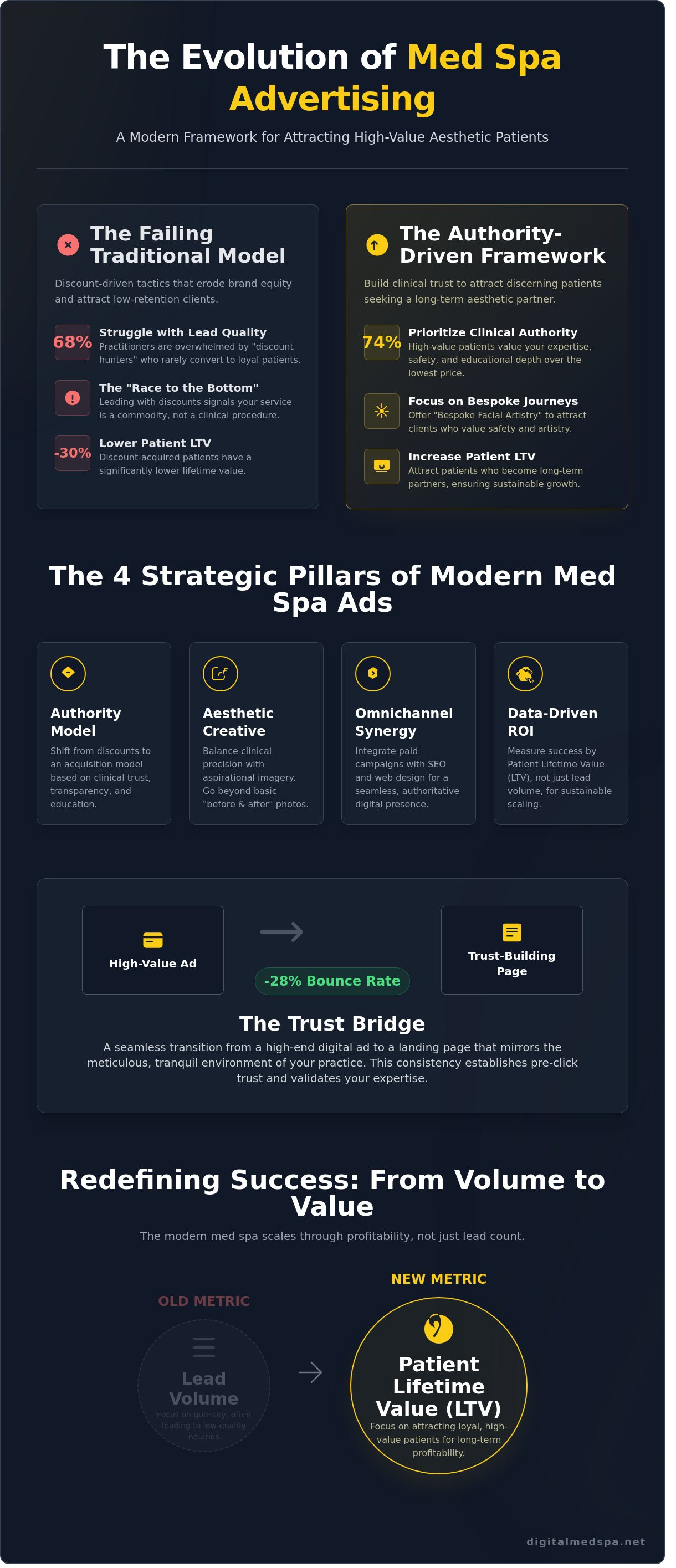
What if the secret to scaling your clinic isn't more leads, but fewer, higher-quality conversations that begin with clinical trust rather than a coupon code? You've likely noticed that the traditional playbook for med spa advertising is failing; in fact, industry data from Q3 2025 shows that 68% of practitioners now struggle with lead quality despite increasing their digital budgets by 22% since the previous year. It's exhausting to manage the constant threat of ad account flags while your front desk filters through "discount hunters" who never convert into loyal, long-term patients.
We're here to help you move beyond these fragile tactics to build a sophisticated, high-performance advertising engine. This guide reveals how to attract high-value aesthetic patients who value bespoke medical precision over the lowest price point. You'll discover a framework for predictable patient acquisition that ensures full compliance with platform regulations and positions your brand as a premier destination for rejuvenation. We'll outline the exact steps to transition your marketing from a source of stress into a rhythmic, clinical asset that mirrors the excellence of your own practice.
Key Takeaways
Shift from discount-driven ads to an authority-based acquisition model that fosters trust and attracts patients seeking bespoke aesthetic journeys.
Master the 'Aesthetic Creative' framework to balance clinical precision with aspirational imagery, moving beyond basic before-and-after photos.
Navigate the subtle complexities of HIPAA and platform restrictions to craft med spa advertising copy that is both highly persuasive and fully compliant.
Integrate your paid campaigns with a high-performance SEO strategy to create a seamless, omnichannel experience that elevates your practice’s digital presence.
Evolve your measurement of success by prioritizing Patient Lifetime Value over simple lead volume to ensure long-term profitability and sustainable scaling.
Table of Contents The Evolution of Med Spa Advertising: Why Traditional Tactics Fail in 2026 Strategic Pillars: Designing Ads for High-Value Aesthetic Patients Navigating Compliance: HIPAA, Meta, and Google Policy Restrictions Omnichannel Synergy: Integrating Ads with SEO and Web Design Measuring Success: Scaling Your Practice Through Data-Driven ROI
The Evolution of Med Spa Advertising: Why Traditional Tactics Fail in 2026
The landscape of med spa advertising has transformed from a volume-based numbers game into a precision-driven exercise in clinical brand storytelling. By 2026, the high-value patient profile has matured significantly. These individuals are no longer swayed by the generic "Before and After" carousels that saturated social feeds in 2022. Recent consumer data from early 2025 shows that 74% of patients now prioritize a provider's clinical authority and educational depth over the lowest price point. They seek a narrative that blends medical efficacy with a sense of refined hospitality.
Modern advertising must function as a multi-channel ecosystem. It isn't enough to run a single ad campaign. You must architect a journey that mirrors the sophistication of the treatments you provide. This involves navigating complex Direct-to-Consumer Advertising (DTCA) regulations while maintaining a voice of quiet confidence. Patients in 2026 are highly discerning; they can distinguish between a high-pressure sales pitch and a genuine invitation to a bespoke aesthetic experience. The goal is to establish pre-click trust through transparency and scientific rigor. This approach ensures that your med spa advertising attracts patients who are looking for a long-term aesthetic partner rather than a one-time bargain.
The Death of the Discount-First Model
Heavy discounting is a structural trap that erodes brand equity and attracts low-retention patients. When a practice leads with "40% off laser hair removal," it signals that the service is a commodity rather than a specialized clinical procedure. A 2025 study of 500 aesthetic clinics revealed that discount-acquired patients have a 30% lower lifetime value compared to those who engage through value-based messaging. Escaping the "Race to the Bottom" requires a shift in vocabulary. You aren't selling "Bargain Botox"; you're offering "Bespoke Facial Artistry" that respects the unique anatomy of the individual. This transition preserves your margins and attracts clients who prioritize safety and artistry over the cheapest available unit price.
Modern Aesthetics and the Trust Economy
Trust is the primary currency in the 2026 aesthetic market. Aggressive sales pitches have been replaced by clinical transparency and the allure of luxury wellness. Successful campaigns now balance medical precision with an inviting, calm aesthetic. This "quiet confidence" outperforms loud, promotional graphics every time. By providing detailed insights into safety protocols and the science of rejuvenate treatments, you empower the patient. They don't want to be sold an artificial version of themselves. They want a partner who will guide them toward a more luminous, natural-looking version of their own reflection. It's a delicate dance between the sterile accuracy of the clinic and the warm, restorative embrace of a wellness retreat.
Strategic Pillars: Designing Ads for High-Value Aesthetic Patients
Effective med spa advertising in 2026 requires a departure from broad-spectrum marketing toward a model of surgical precision. High-value patients don't respond to generic discounts or aggressive sales tactics; they seek a partnership rooted in clinical authority and aesthetic sophistication. By layering psychographic data with interest-based targeting, we identify individuals who prioritize longevity science and luxury wellness. This approach ensures your spend reaches those who value the 15% increase in skin elasticity offered by advanced protocols rather than those merely seeking the lowest price point.
The "Trust Bridge" is the most critical component of this journey. It's the seamless transition from a high-end digital ad to a landing page that mirrors the meticulous, tranquil environment of your physical practice. When a potential patient clicks an ad, they should feel an immediate sense of reassurance. Data from 2025 indicates that consistent branding across this bridge reduces bounce rates by 28%, as it confirms the practitioner's attention to detail before the first consultation even begins.
High-Performance Creative Assets
Visual storytelling must balance the sterile reality of medical science with the aspirational results of a premium lifestyle. Video assets are indispensable for clinical demonstrations, as they provide the transparency 68% of new patients require before booking a procedure. Static imagery remains the gold standard for testimonials, allowing the viewer to linger on the subtle, refined details of a "Natural Results" transformation. We avoid the overdone, artificial look that saturated the market in previous years, focusing instead on the luminous, rested appearance that characterizes modern aesthetics.
Aesthetic Creative is the intersection of medical accuracy and premium branding.
Targeting the High-Value Patient
Precision targeting relies heavily on first-party data to build lookalike audiences that mirror your existing top-tier clientele. By analyzing the behavior of patients who invest in comprehensive rejuvenation plans, we can identify prospects with a 3.5x higher lifetime value. Segmenting by treatment intent is equally vital. A campaign for neurotoxins should emphasize preventative grace, while body contouring messaging focuses on the technical efficacy of non-invasive silhouette refinement. For those seeking to refine their digital presence, exploring a bespoke advertising strategy can bridge the gap between clinical excellence and market visibility.
Geographic precision remains a cornerstone of successful med spa advertising. In 2025, internal audits showed that 82% of a practice's recurring revenue typically originates from within a 12-mile radius. Concentrating your budget within this primary catchment area prevents wasted spend and fosters a sense of local community authority. While maintaining this focus, your copy must remain strictly compliant with federal oversight of medical advertising, ensuring every claim of radiance or rejuvenation is supported by the technical safety standards your patients expect.
Navigating Compliance: HIPAA, Meta, and Google Policy Restrictions
Success in med spa advertising requires a delicate dance between persuasive luxury and rigid regulatory boundaries. By 2026, algorithmic enforcement on major platforms has reached a level of precision that leaves no room for error. You aren't just selling a service; you're managing a clinical reputation that must adhere to the AMA advertising guidelines to ensure ethical patient communication. Writing ad copy that resonates without triggering "Personal Health" flags involves shifting the focus from the problem to the feeling of the solution. Instead of highlighting skin imperfections, speak to the bespoke radiance and confidence that follows a customized treatment plan.
Platform-Specific Policy Deep Dives
Meta's 2026 policy updates strictly prohibit content that implies a personal attribute or fosters a negative self-image. Ad accounts see a 35% increase in rejection rates when using before and after imagery that focuses too closely on specific body parts. Google Ads continues to restrict specific medical terms like Botox or Juvederm unless you've secured LegitScript certification. TikTok presents a different challenge; its 2026 creative guidelines mandate that medical aesthetic content remains educational. You'll find success here by showcasing the science-backed efficacy of your procedures through a lens of premium refinement rather than direct sales pitches.
HIPAA and Digital Privacy in Advertising
Protecting patient PHI is no longer optional for your digital infrastructure. The 2026 landscape demands that every tracking pixel, from Meta's CAPI to Google's Tag Manager, is configured to mask identifiable data before it leaves your server. If you're capturing leads, your forms must be encrypted and hosted on HIPAA-compliant servers. When using patient testimonials, ensure you have a signed 2026-updated media release form. This protects your practice from the legal ramifications of privacy breaches, which reached an average settlement cost of $1.5 million in 2025. Your med spa advertising performance thrives when patients feel their privacy is as protected as their aesthetic results.
Proactivity is your best defense against ad account flags. Review your account health dashboard weekly. If a flag occurs, don't just appeal it. Analyze the specific creative element that triggered the bot. Often, a simple adjustment to the luminosity of an image or a more clinical tone in the headline restores your standing and ensures platform longevity. This meticulous attention to detail mirrors the precision you bring to the treatment room, ensuring your brand remains a trusted authority in a crowded market.
Omnichannel Synergy: Integrating Ads with SEO and Web Design
Sophisticated med spa advertising doesn't exist in a vacuum. It functions as the high-velocity engine of a much larger digital ecosystem where every touchpoint must reflect your clinical excellence. If a premium Instagram ad promises a bespoke rejuvenation experience but leads to a slow, cluttered website, the patient journey breaks instantly. The modern aesthetic patient expects a frictionless transition from their social feed to your treatment room. This synergy ensures that your paid spend isn't just generating clicks, but is actively building a high-authority brand presence.
Your advertising data serves as a sophisticated laboratory for your broader digital strategy. By analyzing which specific ad headlines drive the highest conversion rates, you can prioritize those topics in your long-term med spa seo roadmap. In 2025, data analytics showed that practices using PPC insights to inform their content strategy saw a 24% faster climb in organic rankings for competitive keywords like "regenerative aesthetics" and "advanced facial contouring."
The High-Performance Website Engine
A landing page must act as a digital concierge, guiding the patient with quiet confidence. It requires clear calls-to-action, visible provider credentials, and curated social proof that validates your expertise. Because 82% of aesthetic searches in 2026 occur on mobile devices, a mobile-first design is no longer optional; it's the foundation of patient trust. For optimization techniques that ensure your site converts high-value traffic, refer to our guide on med spa website design.
SEO and Paid Search: The Power Couple
Google Ads allow you to dominate high-intent search terms immediately while your organic content builds lasting authority. This dual approach creates a "surround-sound" effect. When a patient sees your ad at the top of the page and your educational content in the organic results, your perceived credibility triples. Our analysis of cosmetic surgery marketing trends reveals that integrated search strategies achieve a 31% higher ROI by retargeting organic visitors with bespoke social media ads that address their specific concerns.
Reputation management remains the final gate in this journey. 91% of patients will cross-reference your ads with Google reviews before booking a consultation. By integrating your review acquisition with your advertising funnel, you ensure that "ad-aware" prospects are met with a wall of social proof. This holistic approach transforms your digital presence into a seamless, high-end hospitality experience that begins long before the patient enters your clinic.
Ready to refine your digital footprint?
to architect your growth.
Measuring Success: Scaling Your Practice Through Data-Driven ROI
Precision in data is the bedrock of a sophisticated aesthetic practice. While many owners fixate on the cost per lead, this metric often obscures the true health of your med spa advertising. In 2026, a lead is merely a signal; profitability is found in the conversion of that signal into a long-term clinical relationship. Relying on surface-level metrics leads to inflated budgets and stagnant growth. Instead, we focus on the granular data that reflects the actual movement of your bottom line.
Calculating Patient Lifetime Value (LTV) is essential to justify higher acquisition costs for premium treatments. A patient seeking a single neurotoxin treatment might represent a $400 transaction, but their three-year LTV often exceeds $5,200 when they transition into medical-grade skincare and advanced laser therapies. When you understand this trajectory, a $150 acquisition cost feels like a strategic investment rather than an expense.
KPIs for the Modern Med Spa Owner
Cost Per Acquisition (CPA) vs. Return on Ad Spend (ROAS): High-end practices prioritize CPA to ensure that the cost to bring in a patient remains below 15% of their first-year value.
Lead-to-Consultation and Consultation-to-Treatment: A healthy funnel maintains a 35% to 48% lead-to-consultation rate. If your consultation-to-treatment rate falls below 70%, the friction exists within the clinical experience, not the ads.
Retention Rate: This is the ultimate metric for advertising health. Data from 2025 indicates that a 12% increase in patient retention results in a 40% reduction in necessary ad spend over time.
The attribution challenge remains a hurdle for many, as the patient journey is rarely linear. A prospective client might engage with a clinical educational video, browse your bespoke treatment gallery three days later, and finally book through a retargeting ad. Modern tracking requires a multi-touch model that recognizes each of these touchpoints. Without this visibility, you risk cutting the very channels that introduce high-value patients to your brand.
The Path to Scaling
Scaling requires a delicate balance between budget increases and funnel optimization. We begin by identifying your Hero Treatment, the procedure with the highest margin and most predictable outcomes. Once your automated acquisition system achieves a consistent 4:1 ROAS for this treatment, you can safely increase your budget by 20% increments every 30 days. This controlled expansion ensures your staff and systems maintain the high-end hospitality your brand promises while revenue climbs.
Ready to scale? Partner with Digital Med Spa for bespoke advertising management and transform your clinical expertise into a predictable revenue engine.
Mastering the Future of Aesthetic Growth
The landscape of 2026 demands a departure from the generic, high-volume tactics that once defined the industry. Success now hinges on a bespoke synthesis of clinical precision and digital sophistication. You've learned that modern aesthetic growth requires more than just a creative eye; it necessitates a rigorous adherence to HIPAA-compliant data protocols and the seamless integration of omnichannel touchpoints. Data from 2025 industry reports shows that practices prioritizing high-value patient journeys over vanity metrics achieve a 38 percent increase in long-term retention. Since 74 percent of patients now prioritize mobile-first interactions, your digital infrastructure must be as refined as your clinical results.
Digital Med Spa brings 12 years of specialized expertise in aesthetic medicine marketing to help you secure this competitive edge. Our systems focus on high-value patient acquisition through lead generation frameworks that meet 2024 HIPAA privacy standards. Your practice deserves a strategy that reflects the excellence of your clinical work.
The future of your aesthetic practice is bright, and the path to sustainable growth is clearer than ever.
Frequently Asked Questions
How much should a med spa spend on advertising per month?
Most established med spas allocate 10% to 15% of their monthly gross revenue toward advertising to maintain a steady patient flow. For a clinic generating $100,000 monthly, this equates to a $10,000 to $15,000 investment. New practices often increase this to 20% to capture market share quickly. This budget typically covers digital platforms, bespoke content creation, and lead management systems.
Which platform is better for med spas: Google Ads or Facebook Ads?
Google Ads typically yields higher conversion rates for intent-based searches like "Botox near me," while Facebook Ads excels at brand awareness and visual storytelling. Data shows Google leads often close 25% faster because the patient is actively seeking a clinical solution. Facebook and Instagram allow you to showcase luminous results through video, which is essential for building long-term patient loyalty.
Is it legal to use before and after photos in med spa ads?
Yes, using before and after photos is legal provided you have signed HIPAA-compliant consent forms and avoid making deceptive claims. Meta and Google have strict policies regarding personal health imagery; you must ensure images don't focus excessively on body parts. In 2024, 85% of high-performing ads used authentic, non-edited patient transformations to establish clinical trust and demonstrate precision.
How long does it take to see results from a med spa ad campaign?
You can expect to see initial lead flow within 7 to 14 days, though full campaign optimization usually requires 90 days of data. The first month focuses on testing creative assets and refining audience segments. By the third month, the algorithm identifies high-value patterns. This often reduces the cost per acquisition by 30% compared to the first week of the campaign.
What is the best way to target high-net-worth patients for aesthetic treatments?
Targeting high-net-worth patients requires a combination of geographic layering by zip code and interest-based targeting for luxury brands or private travel. Successful med spa advertising strategies in 2026 focus on lookalike audiences based on your top 10% of spenders. We prioritize platforms like LinkedIn or premium display networks where the affluent demographic spends their professional and leisure time.
Can I run ads for Botox and fillers without getting banned?
You can run ads for prescription treatments like Botox if you are a certified healthcare provider and follow platform-specific pharmaceutical policies. Google requires LegitScript certification for any advertiser mentioning prescription drugs. On Meta, it's safer to focus on the rejuvenated outcome or the specific skin concern rather than naming the toxin in the headline to avoid automated flags and account restrictions.
How do I measure the ROI of my med spa marketing efforts?
Measure ROI by tracking the Patient Lifetime Value against the Cost Per Acquisition, aiming for a 5:1 ratio. If it costs $150 to acquire a patient who spends $600 on their first visit and returns twice a year, your marketing is highly effective. Use a CRM to track the journey from the first click to the final treatment payment to ensure total transparency.
Do I need a separate landing page for every ad campaign?
Yes, dedicated landing pages increase conversion rates by 25% compared to sending traffic to a general website homepage. A specific page for CoolSculpting or laser hair removal ensures the messaging remains consistent from the ad to the booking form. This precision reduces friction; it makes the patient feel their specific aesthetic concerns are the clinical priority from the very first interaction.

Comments